

I’ve always loved stargazing in the city, despite the challenge of light pollution. It’s tough to see the stars with all the artificial light around. But, a new tech is making it easier for city stargazers like me. Have you heard of Electronically Assisted Astronomy (EAA)?
EAA is changing the game for city sky watchers. It uses advanced cameras and software to help us see the stars better. Now, we can take amazing photos and watch the stars live, even in bright cities.
Key Takeaways
- EAA is revolutionizing urban astronomy by overcoming the challenges of light pollution.
- Advanced CMOS camera sensors and software like SharpCap are enabling shorter exposure times and better performance in cities.
- EAA provides a more engaging and immediate viewing experience, allowing stargazers to see deep-sky objects in real-time.
- Smart telescopes and integrated camera-telescope systems are making EAA more accessible and convenient for urban astronomers.
- EAA is empowering amateur astronomers to capture stunning astrophotography and observations, even from the heart of the city.
Revolutionizing Astrophotography with CMOS and SharpCap
CMOS sensor technology has changed the game in CMOS astrophotography. These cameras have much less read noise than old CCD sensors. This means they can take pictures in shorter times without losing quality. This is great for urban astrophotography, where there’s a lot of light pollution and tracking is hard.
The Advantages of CMOS Sensors
CMOS sensors are better because they have less read noise. This lets astrophotographers take pictures in just 4 to 8 seconds and still get great results. This is a big deal for urban astronomy. It means you can use smaller, easier to carry mounts instead of big ones needed for long shots.
Taking Advantage of Short Exposures
By combining these short shots, EAA fans can take clear pictures of deep-sky objects even in places with a lot of light. This method helps reduce tracking mistakes and makes observing more fun and interactive. Robin Glover, the SharpCap software creator, has been key in making CMOS cameras work better for astrophotography.
“The lower read noise of CMOS sensors means that astrophotographers can use much shorter exposure times, often as little as 4 to 8 seconds, and still achieve high-quality results.”
Introducing Electronic Assisted Astronomy (EAA)
Electronic Assisted Astronomy (EAA) is changing how amateur astronomers see the night sky. It uses digital cameras, image processing software, and new tech. This gives stargazers a unique and instant experience. It’s different from old ways of looking at the stars or taking long photos of space.
EAA lets people see deep-sky objects as they happen. It doesn’t need long photo times to show faint stars and planets. Instead, it uses short photos that get better as they stack up. This lets astronomers see how galaxies and nebulae change over time, making them clearer and more detailed.
Electronic assisted astronomy, or EAA, combines with astrophotography technology to open new doors in amateur astronomy. Now, people can see deep-sky objects live, something only pros could do before.
“EAA has revolutionized the way I engage with the cosmos. The ability to see deep-sky objects in real-time, with continuously improving detail, has reignited my passion for astronomy.”
The tech behind EAA is getting better, making the future bright for amateur astronomy. It’s making exploring the universe more immersive and easy for everyone.
Instant Gratification: Seeing Deep Sky Objects in Real-Time
Electronic Assisted Astronomy (EAA) lets us see deep-sky objects as they happen. With CMOS sensors and software like SharpCap, we can watch images come together in real-time. This “live stacking” method is a big deal. It shows us nebulae, galaxies, and other faint objects that were hard or impossible to see before.
Seeing the image change right before our eyes is amazing. It’s making more people interested in urban astronomy. We don’t have to wait for hours or spend a lot of time processing photos. EAA lets us see the beauty of the sky in real-time, which is truly captivating.
Live Stacking and Short Exposures
Live stacking is key to this real-time viewing. CMOS sensors can take and combine many short photos quickly. This makes a final image that’s much better than one long photo. Special software helps this process, giving us clear and detailed images.
This mix of real-time astronomy, EAA, live stacking, and seeing deep-sky objects is a big step forward. It’s exciting and inspiring for new sky watchers in cities and suburbs.
Urban Astronomy: Overcoming Light Pollution
I love looking at the stars, but living in a city makes it hard. The bright lights from buildings and streets block our view of the sky. This makes it hard to see most stars and planets.
Then, I discovered Electronic Assisted Astronomy (EAA). It uses special cameras and software to help us see the stars better, even with city lights. This technology lets me see amazing things from my backyard or a park. It made me love looking at the stars again.
EAA helps us see things in the sky that are hard to see because of city lights. I can now see galaxies, nebulae, and star clusters up close. This has made me more passionate about looking at the stars from the city. It also made me realize how important it is to keep the night sky dark for the future.
“EAA has revolutionized my experience of urban astronomy, allowing me to uncover the hidden gems of the cosmos right in my own backyard.”
I’m excited to share what I’ve learned with others. I want to inspire people to enjoy stargazing in the city again. With EAA, we can all be urban astronomers, connecting with the stars that have amazed us for so long.
Smart Telescopes: The Future of Amateur Astronomy
Smart telescopes have changed the game for amateur astronomers. They make stargazing easy and fun. These systems combine a telescope and camera into one, letting you see the stars in real-time.
Integrated Telescope and Camera Systems
Companies like Unistellar and Vaonis have created easy-to-use smart telescopes. The EVScope and Vespera II bring together the telescope, mount, and camera in one. They’re portable, simple to set up, and easy to use. This makes astronomy fun for more people, even those in cities.
Accessibility and Convenience
Smart telescopes make stargazing easy by combining everything you need in one. They have features like automatic setup, real-time image processing, and easy image capture. This has changed how we enjoy the night sky. Now, both experts and beginners can easily explore the stars with smart telescopes.
“Smart telescopes have truly democratized the realm of amateur astronomy, making it accessible to a wider audience than ever before.”
Comparing Smart Telescope Options
The smart telescope market is growing fast. It’s key to look at the features of different models. The Vespera II by Vaonis and the EVScope 2 by Unistellar stand out. Each has its own strengths and things to consider.
Vespera II vs EVScope 2
The Vespera II is compact and has a sensitive CMOS sensor. It also has an autofocusing system. This makes it perfect for city dwellers who want something easy to carry and use.
The EVScope 2 has a longer focal length and a built-in eyepiece. It also lasts longer on a battery. It’s ideal for those who like a classic observing experience.
| Feature | Vespera II | EVScope 2 |
|---|---|---|
| Sensor Type | CMOS | CMOS |
| Focal Length | 400mm | 700mm |
| Aperture | 80mm | 114mm |
| Autofocus | Yes | No |
| Eyepiece | No | Yes |
| Battery Life | 6 hours | 8 hours |
Knowing the differences between these smart telescope models can help buyers choose the right one. It depends on their needs and what they like.
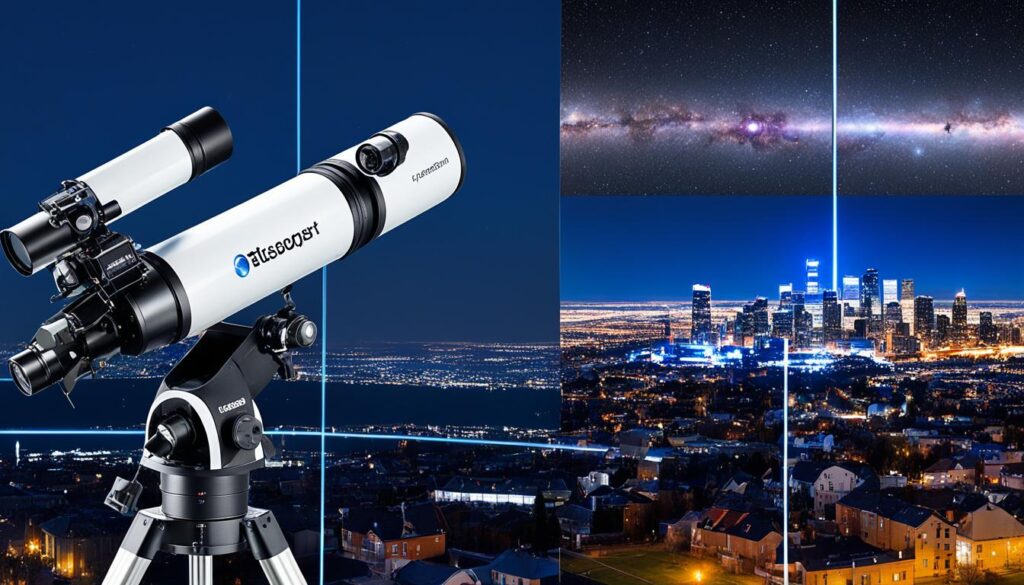
Observing Sessions: Capturing Stunning Views
EAA has changed how we see and capture the night sky, even in cities. It lets us take high-quality pictures of planets and deep-sky objects. This shows us the beauty of the universe in a new way.
Planetary Observations
EAA’s short exposure times and live stacking make planetary imaging better than ever. With just a few seconds, you can see Jupiter, Saturn, and other planets in great detail. These images are as good as what pros use, showing the beauty of our solar system up close.
Deep Sky Imaging in Urban Areas
EAA has also changed deep-sky imaging in cities. It uses live stacking and short exposures to show nebulae, galaxies, and other faint objects. This turns city skies into a place for capturing the universe’s beauty, making it easier for city folks to explore space.
These sessions show how EAA changes our view of the universe. It brings the cosmos closer to city people, showing the big impact of this technology on amateur astronomy.
Challenges and Limitations of EAA
EAA has changed the way we enjoy the stars from cities. But, it comes with its own set of challenges and limits. As someone who loves stargazing, I’ve learned to deal with these issues to enjoy EAA more.
Light pollution is a big challenge. EAA tries to fight the effects of city lights, but it can still affect how well we see faint stars. I’ve had to adjust how I take pictures and process them to see more clearly.
The stability of the mount and tripod is also important. If they shake or don’t track right, it messes up the live stacking process. This is key for taking clear images. So, I made sure to get a strong and accurate setup.
Battery life is something to think about too. Some EAA telescopes don’t last as long as regular ones, which can be a problem during long nights. I’ve learned to manage my batteries better and plan ahead to avoid running out.
Even with these issues, I believe it’s key to understand and work with them. This way, urban astronomers can make the most of EAA. With some creativity and hard work, we can beat these challenges and enjoy the amazing things EAA offers.

“The key to success in EAA is to embrace the challenges and find creative solutions to overcome them.”
The Impact of EAA on Amateur Astronomy
EAA has changed the game for amateur astronomy, especially for those in cities and suburbs. It makes deep-sky observing and astrophotography easier and more fun. This has sparked a new interest in stargazing among city folks who thought it was too hard.
Now, people can see amazing views of the universe in real-time without needing a lot of gear or knowledge. This has made astronomy more accessible to everyone. As technology gets better and prices drop, EAA will keep changing how we see and connect with the night sky.
EAA is all about making stargazing easy for city folks. Light pollution used to make it tough, but EAA lets people see deep-sky objects from their backyards. This means more people can enjoy the beauty of the universe, inspiring a new wave of amateur astronomers.
| Impact of EAA | Benefit |
|---|---|
| Real-time viewing of deep-sky objects | Increased engagement and excitement for amateur astronomy |
| Overcoming light pollution in urban areas | Expanded access to the night sky for a wider audience |
| Affordability and ease of use | Lower barriers to entry, encouraging new participants |
The EAA impact is growing, and amateur astronomy’s future is bright. With new, easy-to-use technologies coming, more people can enjoy the cosmos. This means a bigger, more diverse group of stargazers.
Conclusion
Electronically Assisted Astronomy has changed how people in cities enjoy the stars. It helps overcome light pollution, making the cosmos more accessible. Thanks to advanced technology, deep-sky observing and astrophotography are now easier for city folks.
As EAA gets better and cheaper, it will keep playing a big role in amateur astronomy. It will inspire more city stargazers to explore the universe from home or local parks. The stories in this article show how EAA is changing astronomy for city people.
EAA has made stargazing easier and more convenient for city folks. It lets them dive deep into astronomy. I’m looking forward to seeing how EAA will change how we see the night sky. It will make the beauty of the stars available to more people than ever.
FAQ
What is Electronically Assisted Astronomy (EAA)?
EAA uses digital cameras and software to enhance astronomy. It changes how amateur astronomers see the night sky. It offers a more immediate and engaging experience than traditional methods.
How does EAA improve astrophotography in urban environments?
EAA captures short exposures to fight light pollution. This lets city folks see deep-sky objects from their backyards or parks. It’s a way to explore the universe from home.
What are the advantages of CMOS sensors for astrophotography?
CMOS cameras have lower read noise than traditional CCD sensors. This means they can take shorter exposures without losing quality. They’re great for urban astrophotography, where light pollution is a big issue.
How does the “live stacking” feature of EAA systems work?
“Live stacking” uses CMOS sensors and software like SharpCap. It lets astronomers see nebulae and galaxies in real-time. The software stacks short exposures to improve the image, offering an instant view.
What are the key features of “smart telescopes” for urban astronomy?
Smart telescopes, like the Vespera II and EVScope 2, combine a telescope, mount, and camera in one. They’re portable, easy to set up, and simple to use. This makes EAA more accessible to city folks.
What are the challenges and limitations of using EAA systems in urban environments?
EAA has made urban astronomy better, but it faces challenges. Light pollution can affect image quality and hide faint objects. Mount stability and battery life are also key, as they affect the live stacking process.
Source Links
- https://www.astrojournals.com/journal/category/emission-nebula – Category: Emission Nebula
- https://www.astrojournals.com/journal/category/evscope – Category: EVScope
- https://aaa.org/2018/11/01/a-discussion-with-robin-glover-about-sharpcap-and-the-electronic-revolution-in-amateur-astronomy/ – A discussion with Robin Glover about SharpCap and the Electronic Revolution in Amateur Astronomy – Amateur Astronomers Association
0 Comments