
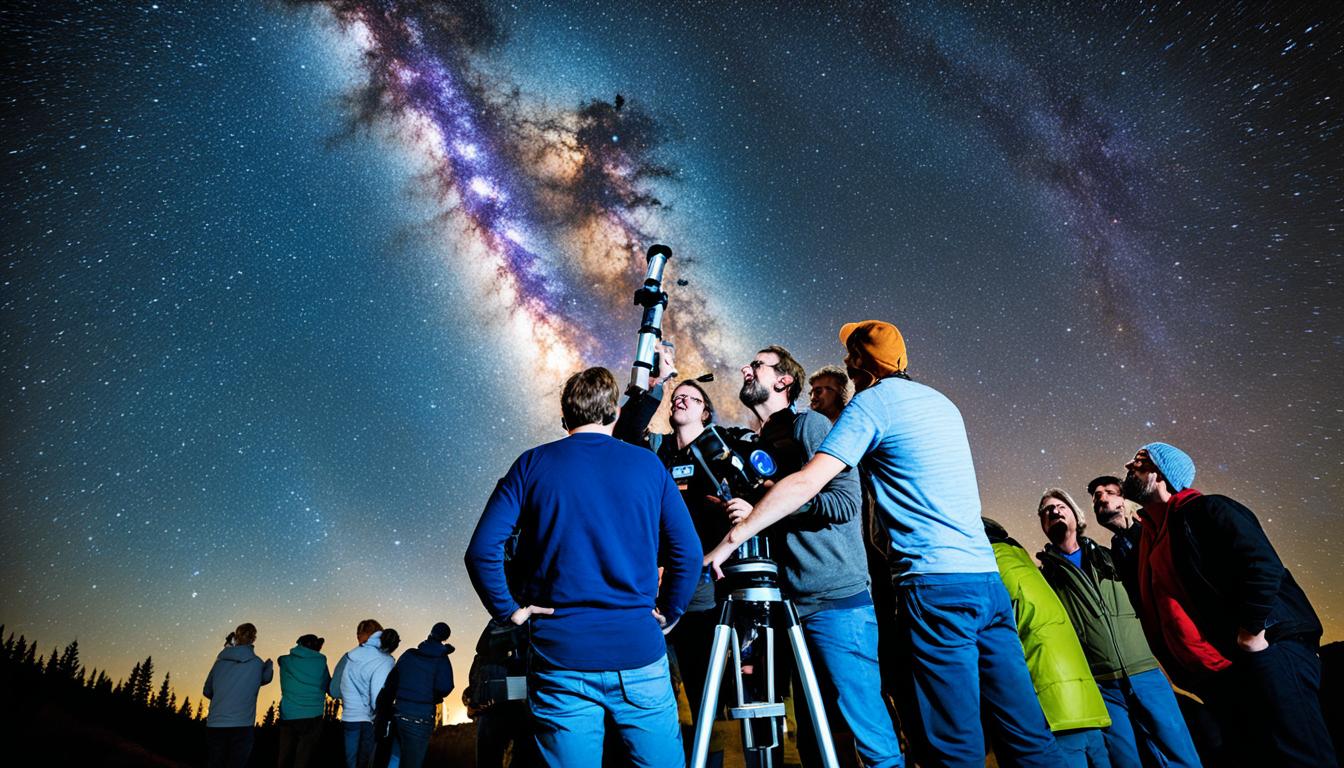
Have you ever looked up at the night sky and wondered about its secrets? Many backyard astronomers around the world are helping us learn about space. They work with professional researchers to find new things.
Before “citizen science” was a thing, astronomy got help from many people who looked at the sky for fun. These amateur astronomers use their own telescopes to explore space. Some even take pictures of what they see, which is called astrophotography.
This teamwork between pros and hobbyists opens new doors. It shows us the huge amount of data and discoveries waiting in the sky.
Key Takeaways
- Amateur astronomers play a vital role in professional astronomical research.
- Backyard enthusiasts contribute valuable data and observations through their personal telescopes and equipment.
- Collaboration between amateurs and professionals leads to new discoveries and a deeper understanding of the universe.
- Amateur astrophotography provides unique perspectives and long-term monitoring of celestial objects.
- Citizen science projects in astronomy engage the public and harness their collective power to support scientific research.
Introduction to Citizen Science
Definition and Historical Background
Citizen science means people like you and me help with scientific research. It’s been around for a long time in astronomy. Amateur astronomers have helped us learn about the stars and space for years.
People have been helping with science for hundreds of years. They’ve recorded stars and found new ones. Their work has helped us understand the universe better.
Importance of Amateur Contributions
Amateur astronomers are very important in science. They bring new ideas and a lot of effort. They help collect data and find new things in space.
Now, more than ever, people are joining in on astronomy projects. They use new technology and work together. This helps us learn more about the stars and space.
“Citizen science has become an increasingly important part of the scientific process, allowing researchers to tap into the enthusiasm and expertise of amateur enthusiasts to advance our understanding of the universe.”
| Citizen Science in Astronomy | Amateur Contributions |
|---|---|
| Data Collection | Observations, Photometry, Spectroscopy |
| Data Analysis | Image Processing, Variable Star Monitoring |
| Discovery | Exoplanets, Supernovae, Asteroids |
Collaboration Between Professionals and Amateurs
Professional astronomers and amateur fans work together in a big way. They share data and ideas to make new discoveries. This teamwork helps us learn more about the stars and brings people together.
Experts help guide amateur astronomers. Amateurs add their own views and love for the stars. Together, they make “pro-ams” who can do professional-level work with today’s tech.
Global Astronomy Month shows how important this teamwork is. It makes more people want to join in on astronomy research, data sharing, and community engagement.
“The partnership between professionals and amateurs is crucial for the advancement of astronomy. By combining our knowledge and resources, we can achieve remarkable discoveries that benefit us all.”
This teamwork in astronomy is a great example of how citizen science leads to new ideas and progress. As we keep exploring space, this shared curiosity and hard work will keep us moving forward.
Citizen Science in Astronomy
Amateur astronomers are now a big help to experts in the field. They collect a lot of data through their work. This data is very useful for research.
Many people who love the stars have good cameras and gear. They take pictures of the sky for a long time. This can show things that big telescopes might miss.
Projects like Astro Pro-Am use the work of citizen scientists to help experts. By mixing amateur photos and data with pro skills, we can make new discoveries. This helps us learn more about the universe.
Notable Citizen Science Projects in Astronomy
- NASA’s Backyard Worlds: Planet 9 program gets help from citizens to find Planet 9 and new brown dwarfs. They use data from the WISE mission.
- Planet Hunters TESS lets people help find planets around stars close to us. They look at data from the Transiting Exoplanet Survey Satellite.
- The Globe at Night campaign asks people to report on light pollution. This helps protect dark skies and studies light pollution’s effects.
- The Galaxy Zoo program has volunteers classify galaxies by shape. This helps scientists understand how galaxies form and change.
These are just a few examples of how citizen science helps astronomy. By joining these projects, people like you help us learn more about the universe.
“Citizen science in astronomy has been a game-changer, allowing us to tap into a vast network of enthusiastic amateur observers and astrophotographers to support our professional research efforts.”
Amateur Astrophotography and Data Collection
I love the art of astrophotography and how it helps with research. Now, with better telescopes and cameras, we can all help with science. It’s exciting to be part of it.
Equipment and Techniques
I use a 17.5-inch telescope and a high-resolution camera. These tools let me take amazing pictures of stars and galaxies. To do amateur astrophotography, I line up the telescope right, adjust settings, and combine photos to get more detail.
I also collect data on stars and other changing objects in space. By tracking their brightness and color, I help scientists with their work.
“The data collected by citizen scientists was published in the Research Notes of the American Astronomical Society.”
I helped study a supernova in the Pinwheel Galaxy, 21 million light-years away. I took 252 photos over 35 days with my 10-inch telescope. This helped track how bright it got and how it faded.
As amateur astrophotographers, we’re key to understanding the universe. Working with pros, we make a big difference in astronomy.
Combining Amateur and Professional Data
Working together, amateur astronomers and professional researchers have opened new doors. They use image processing and data analysis. This mix of amateur and professional data gives us new insights into space.
Harnessing the Power of Image Processing
Amateur photographers take amazing pictures of the sky. But these pictures are more than pretty. With advanced image processing, we can turn these pictures into valuable data. This data can be used with professional observations.
This group of galaxies shows how we combine different types of data. We use X-ray data from NASA’s Chandra X-ray Observatory, infrared data from the Spitzer Space Telescope, and pictures from amateur astronomers. This way, we get a full view of these galaxies, showing their details and secrets.
This teamwork does more than just share NASA’s data. It shows how important amateur astronomers are. They help us learn more about the universe.
“The images in this quartet of galaxies represent a sample of composites created with X-ray data from NASA’s Chandra X-ray Observatory, infrared data from the Spitzer Space Telescope, and optical data collected by amateur astronomers.”
As we keep exploring space, working together will lead to new discoveries. It will help us understand our place in the universe better.
Citizen Science Projects and Initiatives
Astronomy is a big and exciting field. Citizen science projects let amateur astronomers work with pros. They help with big research projects. This lets people from everywhere join in and learn more about space.
PARC (Professional Amateur Research Collaborations) is one way for amateur astronomers to work with experts. They can join projects that match their skills and interests. This lets them be part of real science projects.
There are many other projects like PARC for astronomy fans. Zooniverse has over 100 projects that anyone can join. You can help with things like classifying galaxies or finding new planets. There are also projects in Earth and Animal Sciences for more variety.
Projects like NatureWatch, eBird, and Globe at Night ask for your help too. You can collect data and share it with scientists. This helps with big research and makes a community of astronomy fans.
Technology has made it easier for people to help with science. Now, you can do things like classify images or work on algorithms. This helps you learn more about STEM subjects.
The number of people helping with science is growing. Amateur astronomers can work with experts on many projects. If you like looking at the stars or just want to learn more, there’s a place for you in citizen science.
“Citizen science projects are not only advancing scientific research, but also empowering individuals to become active contributors to the scientific process. By engaging with these initiatives, amateur astronomers can play a vital role in uncovering the mysteries of the cosmos.”
Amateur Astronomy Societies and Organizations
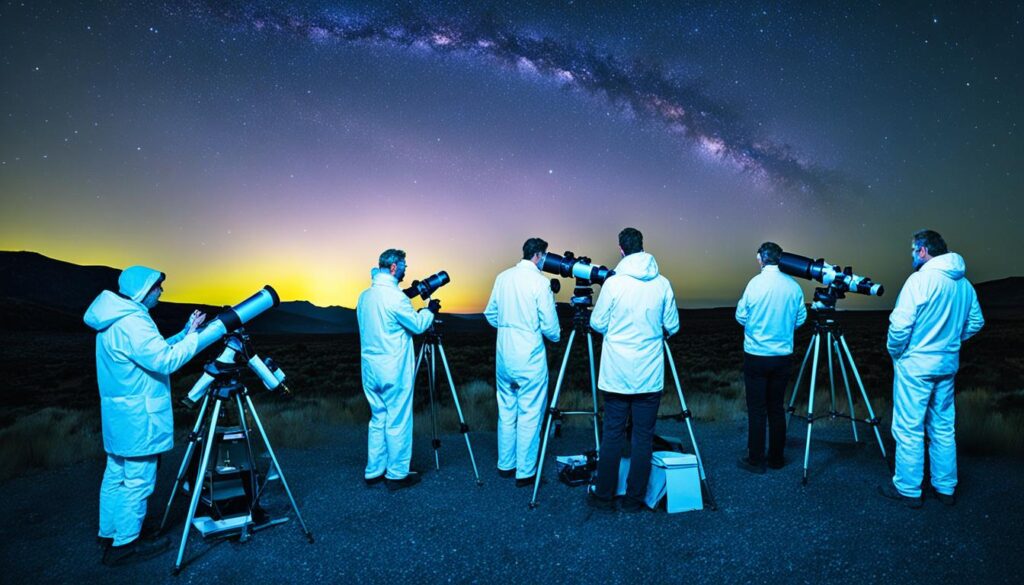
Amateur astronomers join groups all over the world. These groups help people work together, learn, and share new discoveries. They make science fun for everyone.
Local and Global Communities
Groups like the Astronomical League in the U.S. offer many ways to get involved. You can help by analyzing data or making observations. You can even send your findings to big databases.
When you help out, you can get special awards. These awards show how much you’ve helped. They go from bronze to gold, based on how much you’ve done.
On a world level, groups like the AAPS and the Pan-African Citizen Science e-Lab connect amateurs and pros. They work on new projects together. This sharing of ideas helps everyone learn and grow.
“The role of citizens in contributing to scientific knowledge is significant, and amateur astronomers play a crucial part in this endeavor.”
Amateur astronomers join clubs at home and work with others around the world. This shows how much we can do when we work together. It’s all about sharing our love for the stars.
Challenges and Limitations
Working together, amateur and professional astronomers have made great progress. But, they face some big challenges. One big issue is the lack of citizen science opportunities for some people, as shown by SciStarter. Many also struggle with technical difficulties when trying to join projects online.
Teachers find it hard to pick citizen science projects for kids. And, financial constraints make it tough to get the needed materials. Plus, interference from nature, like bad weather, animals, and plants, can make it hard for people to help.
- The overwhelming amount of citizen science projects can make it hard for some to keep up.
- Limited access to devices or internet stops some people from joining in.
Despite these problems, the partnership between pros and amateurs in astronomy keeps growing. There are efforts to fix these issues and make amateur astronomers more part of professional research. For instance, the European Commission’s Science with and For Society (SwafS) program gives money to support citizen science.
Citizen science is now seen as a key source of info for official statistical reporting and environmental monitoring, like the United Nations Sustainable Development Goals. As it keeps growing, solving these challenges will help unlock the full power of this way of doing science together.
“Citizen science has been shown to contribute to monitoring five Sustainable Development Goal (SDG) indicators, with potential for another 76 indicators.”
Success Stories and Discoveries
Amateur astronomy is full of amazing stories. People who love the stars have helped scientists a lot. They’ve found new things in space and made big discoveries.
The Sloan Digital Sky Survey got 156 terabytes of data with help from amateur astronomers. The Dark Energy Survey and the Large Synoptic Survey Telescope also get a lot of data. They work with amateurs to learn more about the universe.
Citizen science sites like Zooniverse help amateurs join in. Over 1.6 million people help out. The Galaxy Zoo project got over 150,000 people to classify stars in just a year.
Amateurs have helped with many projects. The Unistellar network made over 4,000 observations in 2022. They even helped track the James Webb Space Telescope with 145 observations.
These stories show how important amateur astronomers are. They work with pros to advance our knowledge of space. They prove that anyone can make a difference in science.
“Citizen scientists play a crucial role in supporting large-scale science projects by offering important insights and contributions.”
Future Prospects and Opportunities
The future of citizen science in astronomy is bright. Technology is getting better and more people like astronomy. With cheap and strong telescopes, more people can help with big science projects.
More opportunities for amateur astronomers to help with professional research are coming. This is because of the work between amateurs and experts.
Working together, amateurs and pros can make big discoveries. This helps us learn more about the universe. Sharing resources and knowledge helps everyone.
Citizen science in astronomy has shown its worth. Amateurs help collect and analyze data. They even find new things in space. As these projects grow, they will have a big impact on astronomy.
Citizen science lets the public join in on science. It helps us learn more and gets kids excited about astronomy. This way of working together could change how we study the universe.
“The future of citizen science in astronomy is bright, as it continues to bridge the gap between professionals and amateurs, driving innovation and inspiring the next generation of space explorers.”
Citizen Science as a Gateway to Astronomy
Citizen science in astronomy grabs the public’s attention. It makes people want to learn more about the stars. By letting people help with real research, these projects make science better and teach us about the universe.
People who love stars can help with things like collecting data and looking at pictures. This helps us learn more about the sky. It makes people feel important and connected to science.
Studies show that these projects really get people interested in astronomy. For example, 87 percent of people in the Neighborhood Nestwatch project learned more about birds. Others learned about science and how to spot invasive species.
Citizen science brings together experts and fans of the stars. It opens up new ways for people to explore and learn. These projects help science grow and can make people want to join astronomy clubs.
“Citizen science projects have grown in popularity and scope over the past two decades across various disciplines such as mammalogy, ornithology, entomology, botany, natural resource management, astronomy, genetics, hydrology, and atmospheric science.”
Citizen science is getting more popular and easy to join. This means more people can help with astronomy. It could inspire a new group of star watchers and connect us all to the stars.
Insights from Citizen Science Participation
- Only 23% of volunteers were singletons (who participated in only one project).
- The multiproject participants were split evenly between discipline specialists (39%) and discipline spanners (38% joined projects with different disciplinary topics).
- The multiproject participants were unevenly split between mode specialists (52%) and mode spanners (25% participated in online and offline projects).
- Multiproject participants were eight times more likely to be White than the general population.
- Multiproject participants were five times more likely to hold advanced degrees than the general population.
| Platform | Volunteers Joining Multiple Projects |
|---|---|
| Zooniverse | 86 out of 104 volunteers |
| Crowdcrafting, Socientize, and GeoTag-X | 16%–32% of volunteers |
| SciStarter | 73% of volunteers |
Conclusion
Amateur and professional astronomers have worked together for a long time. They have made big steps in understanding the universe. Amateur astronomers have helped a lot by collecting data and taking pictures of the sky.
They have also found new things in space. Their hard work is very important. As technology gets better, more people are getting into astronomy. This means more people can help with science.
Working together, amateurs and pros can make new discoveries. They can also inspire new space fans. Everyone brings different ideas and ways of doing things. This makes science better and helps all communities.
Some pros might doubt the quality of amateur data. But, the good things about citizen science in astronomy are clear. With better ways to check data and manage it, amateurs can help more.
Looking ahead, working together is key. It will help us learn more about space and keep people excited about the universe.
FAQ
What is the role of amateur astronomers in professional research?
Amateur astronomers have always helped in astronomy. They study the sky for fun. They help with research by making observations and finding new things in space.
What is the history and importance of citizen science in astronomy?
Citizen science means people help with scientific research. Amateur astronomers have helped a lot over the years. They’ve made big discoveries and helped us learn more about space.
How do professional and amateur astronomers collaborate?
Pro and amateur astronomers work together. They share data and learn from each other. This teamwork is great for astronomy and gets people excited about space.
What are the benefits of citizen science in astronomy?
Citizen science makes astronomy fun for everyone. It lets people join in on real science projects. This can make people love astronomy even more.
What role do amateur astrophotographers play in professional research?
Amateur photographers take long shots of the sky. These shots can show things big telescopes miss. Working together, they make amazing pictures and learn more about space.
What are the challenges and limitations in the collaboration between amateur and professional astronomers?
Working together has its ups and downs. Things like equipment and sharing data can be tricky. But, the good things they do together make it worth it.
What are some notable contributions and discoveries made by amateur astronomers?
Amateur astronomers have found new things in space. They’ve made big discoveries. Their work is a big help to science.
What are the future prospects and opportunities for citizen science in astronomy?
The future looks bright for citizen science in astronomy. With better tech and more people interested, amateurs will have more chances to help with research.
How do amateur astronomy societies and organizations contribute to the field?
Amateur astronomers join groups to share their love for the stars. These groups let them work together, learn, and help with science projects.
Source Links
- https://blog.scistarter.org/2021/05/nasa-is-unleashing-amateur-astronomers-to-help-study-the-night-sky/ – NASA is Unleashing Amateur Astronomers to Help Study the Night Sky | SciStarter Blog
- https://www.iau.org/public/themes/citizen-science-projects/ – International Astronomical Union | IAU
- https://www.citizenscience.gov/about/ – About CitizenScience.gov | CitizenScience.gov
- https://www.nature.com/articles/s43586-022-00144-4 – Citizen science in environmental and ecological sciences – Nature Reviews Methods Primers
- https://jcom.sissa.it/article/pubid/JCOM_1801_2019_A06/ – Citizen science and the professional-amateur divide: lessons from differing online practices
- https://www.degruyter.com/document/doi/10.1515/cti-2018-0032/html – Citizen science – bridging the gap between scientists and amateurs
- https://forum.inaturalist.org/t/community-science-vs-citizen-science/1600?page=3 – "Community Science" vs "Citizen Science"
- https://www.unistellar.com/blog/the-6-best-citizen-science-projects-for-space-lovers/ – THE 6 BEST CITIZEN SCIENCE PROJECTS FOR SPACE-LOVERS – UNISTELLAR
- https://www.skao.int/en/resources/outreach-education/citizen-science – Citizen Science | SKAO
- https://www.esa.int/Enabling_Support/Preparing_for_the_Future/Space_for_Earth/Amateur_astronomers_needed_help_classify_stars_with_Gaia_s_data – Amateur astronomers needed: help classify stars with Gaia’s data
- https://www.seti.org/press-release/record-breaking-team-citizen-scientists-contribute-data-pinwheel-galaxy-supernova – Record-Breaking Team of Citizen Scientists Contribute Data on Pinwheel Galaxy Supernova
- https://www.harvardmagazine.com/node/43528 – Citizen science draws amateurs into scientific research | Harvard Magazine
- https://www.csiro.au/en/news/All/Articles/2023/September/citizen-science-naturalists – Citizen scientists collect more nature data than ever, showing us where common and threatened species live
- https://phys.org/news/2023-09-citizen-scientists-nature-common-threatened.html – Citizen scientists collect more nature data than ever, showing us where common and threatened species live
- https://www.societyforscience.org/research-at-home/citizen-science/ – Research at Home: Citizen Science – Society for Science
- https://en.wikipedia.org/wiki/Citizen_science – Citizen science
- https://www.astroleague.org/citizen-science-special-program/ – Citizen Science Special Program – Astronomical League
- https://participatorysciences.org/about/ – About | Association for Advancing Participatory Sciences
- https://pacselab.space/about/ – About
- https://blog.scistarter.org/2022/06/top-7-citizen-science-problems-and-how-to-solve-them/ – Top 7 Citizen Science Problems (And How to Solve Them) | SciStarter Blog
- https://www.frontiersin.org/journals/environmental-science/articles/10.3389/fenvs.2022.1019628/full – Frontiers | The grand challenges facing environmental citizen science
- https://www.ncbi.nlm.nih.gov/pmc/articles/PMC8022735/ – Citizen Science, Education, and Learning: Challenges and Opportunities
- https://www.discovermagazine.com/the-sciences/zooniverse-a-citizen-science-success-story – Zooniverse: A Citizen Science Success Story
- https://www.unistellar.com/blog/2022-citizen-science/ – A Year in Citizen Science
- https://www.weforum.org/agenda/2023/02/citizen-scientists-archaeology-discoveries/ – 3 incredible examples of citizen science in action
- https://www.nesta.org.uk/feature/emerging-and-desirable-futures-for-citizen-science/ – Emerging and desirable futures for citizen science
- https://faunalytics.org/the-future-of-citizen-science/ – The Future Of Citizen Science – Faunalytics
- https://link.springer.com/chapter/10.1007/978-3-030-58278-4_26 – The Recent Past and Possible Futures of Citizen Science: Final Remarks
- https://www.ncbi.nlm.nih.gov/pmc/articles/PMC9236874/ – Citizen Science as an Ecosystem of Engagement: Implications for Learning and Broadening Participation
- https://informalscience.org/citizen-science-programs-advance-public-understanding-science/ – Citizen science programs advance the public understanding of science
- https://nap.nationalacademies.org/read/25183/chapter/9 – 7 Conclusions and Recommendations | Learning Through Citizen Science: Enhancing Opportunities by Design
- https://www.nature.com/articles/s41599-024-02966-x – Citizen scientists—practices, observations, and experience – Humanities and Social Sciences Communications
0 Comments