
[ad_1]
“I hope you’ll make black holes,” Stephen said with a broad smile.
We exited the cargo lift that had taken us underground into the five-story cavern housing the ATLAS experiment at the CERN lab, the legendary European Organization for Nuclear Research near Geneva. CERN’s director general, Rolf Heuer, shuffled his feet uneasily. This was 2009, and someone had filed a lawsuit in the United States, concerned that CERN’s newly constructed Large Hadron Collider, the LHC, would produce black holes or another form of exotic matter that could destroy Earth.
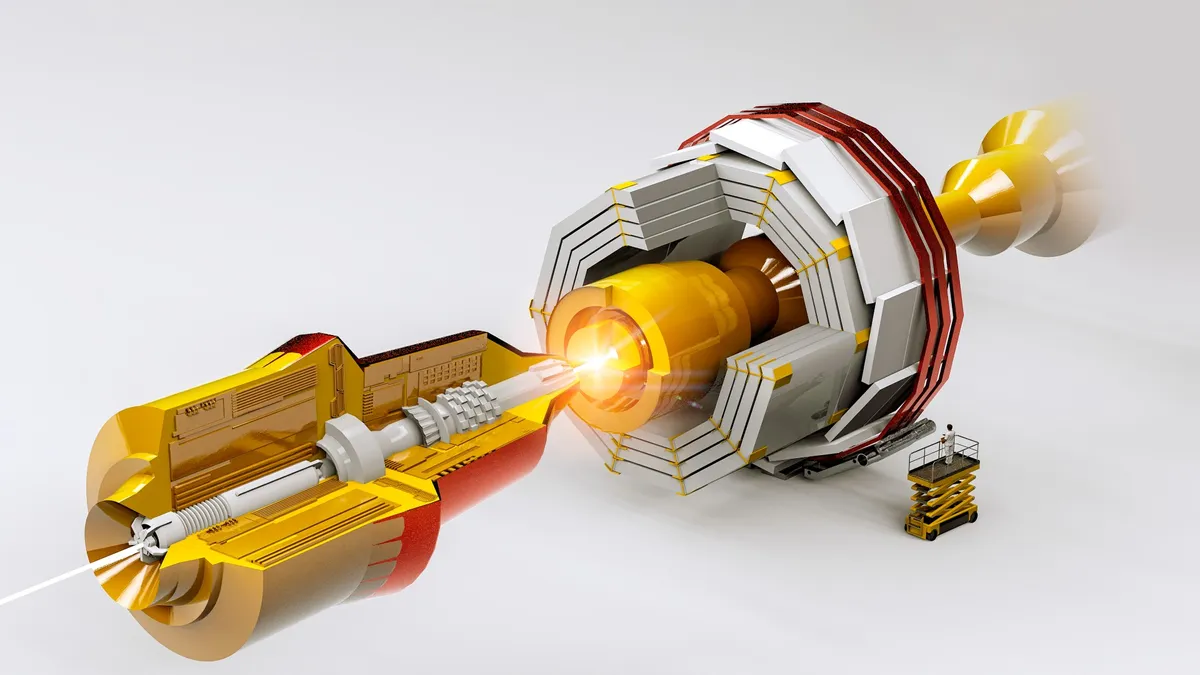
The LHC is a ring-shaped particle accelerator that was built, principally, to create Higgs bosons, the missing link — at the time — in the Standard Model of particle physics. Constructed in a tunnel underneath the Swiss-French border, its total circumference is 27 kilometers (almost 17 miles), and it accelerates protons and antiprotons running in counter rotating beams in its circular vacuum tubes to 99.9999991% of the speed of light. At three locations along the ring, the beams of accelerated particles can be directed into highly energetic collisions, re-creating conditions comparable to those reigning in the universe a small fraction of a second after the hot big bang, when the temperature was more than a million billion degrees. The tracks of the spray of particles created in these violent head-on collisions are picked up by millions of sensors stacked like mini–Lego blocks to make up giant detectors, including the ATLAS detector and the Compact Muon Solenoid, or CMS.
The lawsuit was soon to be dismissed on the grounds that “speculative fear of future harm does not constitute an injury in fact sufficient to confer standing.” In November of that year the LHC was successfully turned on — after an explosion at an earlier attempt — and the ATLAS and CMS detectors soon found traces of Higgs bosons in the debris of the particle collisions. But, so far, the LHC hasn’t made black holes.
Why wasn’t it entirely unreasonable though for Stephen — and Heuer too, I think — to hope that it might be possible to produce black holes at the LHC? We usually think of black holes as the collapsed remnants of massive stars. This is too limited a view, however, for anything can become a black hole if squeezed into a sufficiently small volume. Even a single proton–antiproton pair accelerated to nearly the speed of light and smashed together in a powerful particle accelerator would form a black hole if the collision concentrated enough energy into a small enough volume. It would be a tiny black hole, for sure, with a fleeting existence, for it would instantly evaporate through the emission of Hawking radiation.
At the same time, if Stephen and Heuer’s hope to produce black holes had come true, it would have signalled the end of particle physicists’ decades-old quest to explore nature at ever shorter distances by colliding particles with ever increasing energies. Particle colliders are like microscopes, but gravity appears to set a fundamental limit to their resolution, because it triggers the formation of a black hole whenever we increase the energy too much trying to peek into an ever smaller volume.
At that point, adding even more energy would produce a bigger black hole instead of further increasing the collider’s magnifying power. Curiously, therefore, gravity and black holes completely reverse the usual thinking in physics that higher energies probe shorter distances. The endpoint of the construction of ever larger accelerators doesn’t appear to be a smallest fundamental building block — the ultimate dream of every reductionist — but an emergent macroscopic curved spacetime. Looping short distances back to long distances, gravity makes a mockery of the deeply entrenched idea that the architecture of physical reality is a neat system of nested scales that we can peel off one by one to arrive at a fundamental smallest constituent. Gravity — and therefore spacetime itself — seems to possess an anti-reductionist element.
So at what microscopic scale does particle physics without gravity transmute into particle physics with gravity? (Or, put differently, how much would it cost to fulfil Stephen’s dream of producing black holes?) This is a question that has to do with the unification of all forces, the topic of this chapter. The search for a unified framework that encompassed all basic laws of nature was already Einstein’s dream. It bears directly on whether multiverse cosmology really has the potential to offer an alternative perspective on our universe’s life-encouraging design. For only an understanding of how all particles and forces fit harmoniously together can yield further insights in the uniqueness — or lack thereof — of the fundamental physical laws, and hence at what level one can expect them to vary across the multiverse.
Excerpted from ON THE ORIGIN OF TIME. Copyright © 2023 by Thomas Hertog.
Published by Bantam, an imprint of Penguin Random House.
[ad_2]
Source link
0 Comments