
[ad_1]
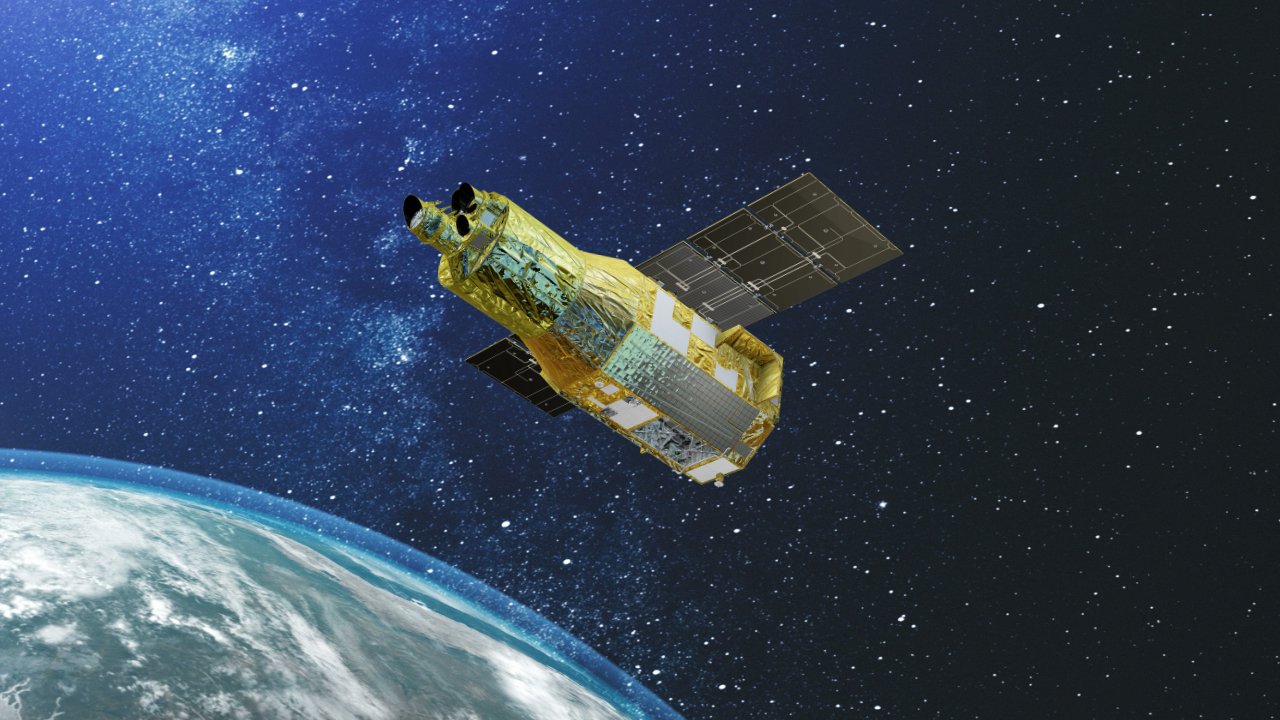
The new observatory will open a new door on the high-energy cosmos as it investigates black holes, galaxy clusters, and more.
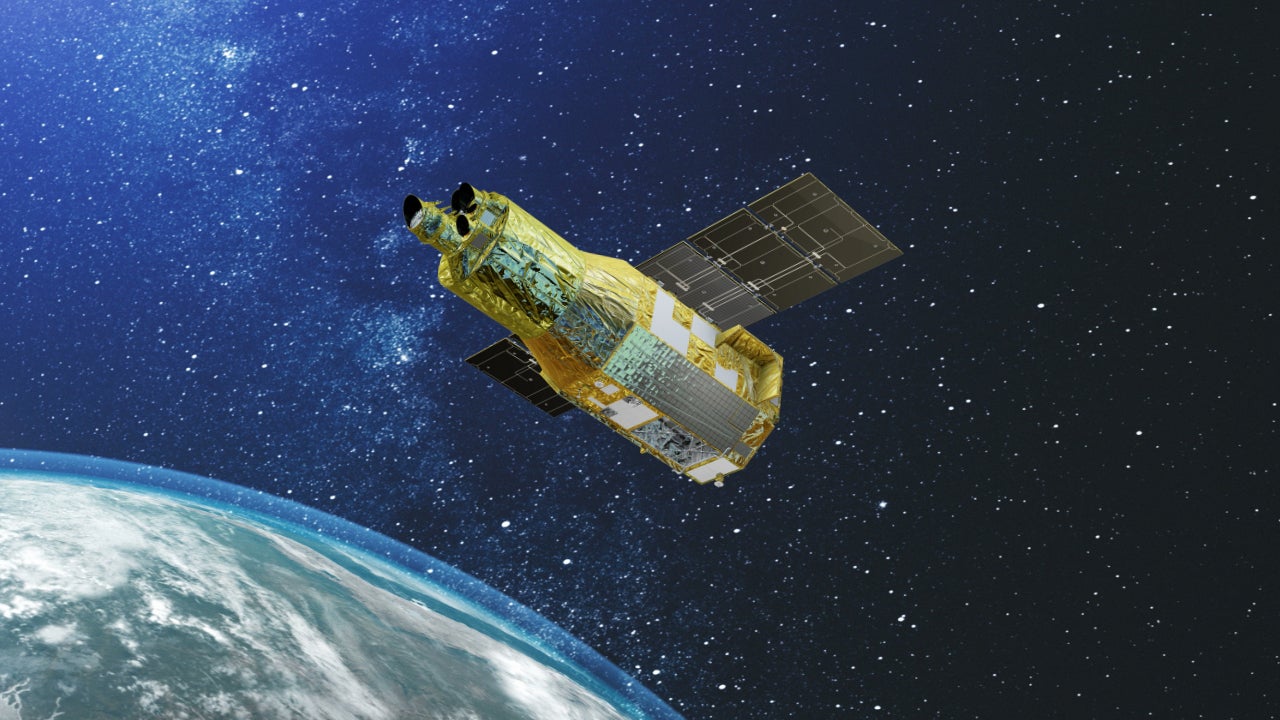
Credit: JAXA
A new X-ray observing mission will change how we see and understand the ultra-hot universe. The X-ray Imaging and Spectroscopy Mission (XRISM), led by the Japan Aerospace Exploration Agency (JAXA), will launch next week on the morning of August 28. (Note the current launch time occurs in the evening of the 27th in the U.S.; for those interested in watching the launch, see the details at the end of the story.) After liftoff, XRISM will move into a low Earth orbit at a height of 340 miles (550 kilometers) and an inclination of 31°.
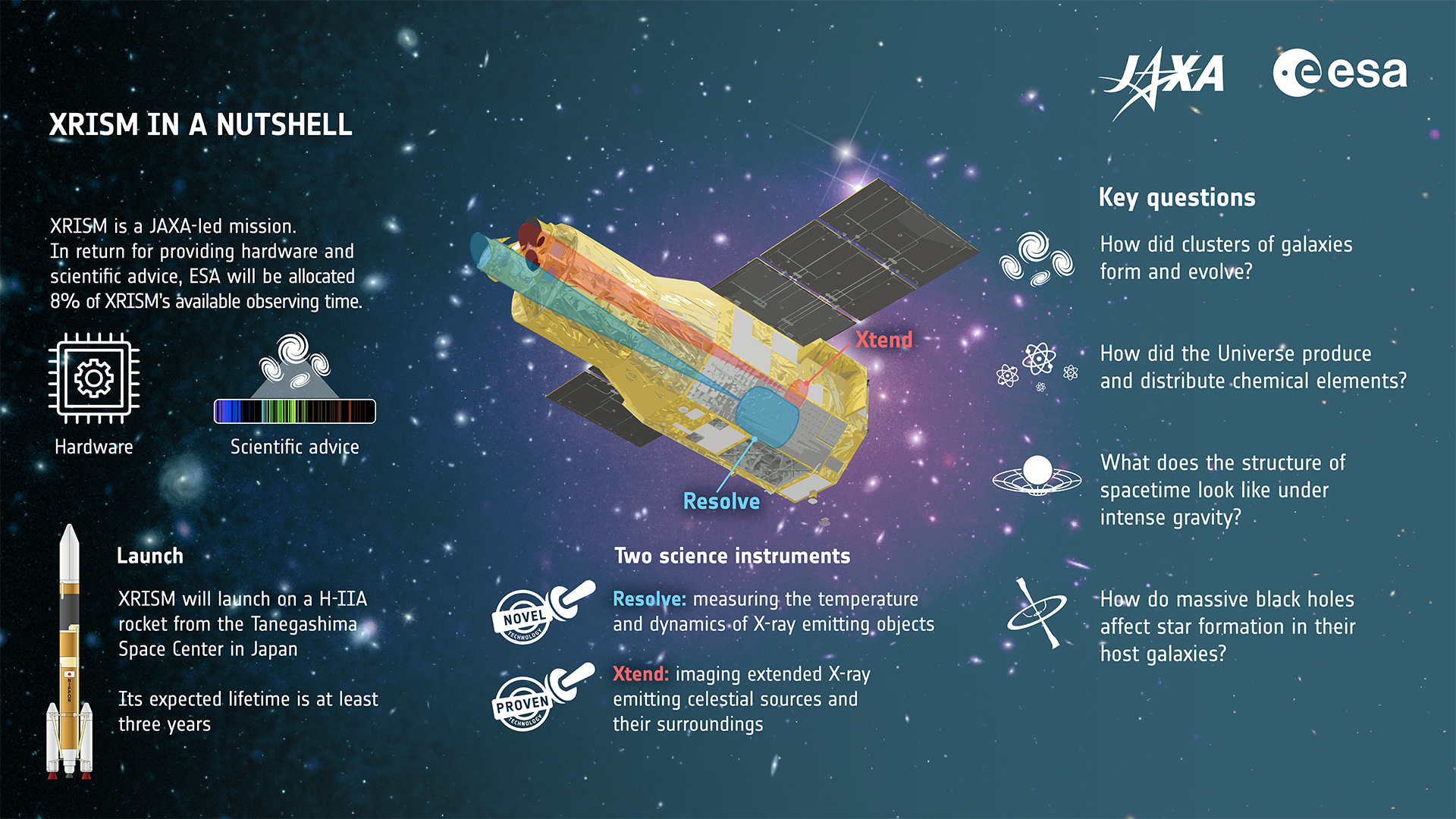
The universe is filled with hot gas that emits energetic light — X-rays — invisible to the naked eye and Earth-bound telescopes. Because energetic and extreme processes produce such light, X-rays hold critical information about the formation and evolution of the universe. XRISM (pronounced “crism”) will help experts understand how clusters of galaxies formed and evolved, how the universe produced and distributed chemical elements, what the structure of space-time looks like under gravity’s intense pull, and how massive black holes affect star formation in their host galaxies.
Capturing energetic light
X-rays are released in the universe’s biggest explosions and hottest places, such as supermassive black holes pulling matter inward into an accretion disk and ejecting jets at high speeds. By observing X-rays from these sources, XRISM can determine the velocities and energies radiating from the gas both swirling in and shooting away from the black hole.
Other sources of cosmic X-rays include the hot gas that lies between galaxies in massive clusters, called the intracluster medium. This gas can reach temperatures of tens of millions of degrees. Studying its composition, which is built up from the continual explosion of massive stars as they die, spreading the elements they forged in their cores out into space, will teach researchers how the chemistry of the universe has changed over time.
XRISM transforms space into an observational laboratory with its two identical mirrors, called X-ray mirror Assemblies (XMA). Unlike classic telescope mirrors, which are polished glass or metal, X-rays utilize a cylindrical construction of thin aluminum foils nestled one inside the other. In total, 1,624 segments make up each XMA. The unique mirrors, assembled at NASA’s Goddard Space Flight Center in Greenbelt, Maryland, reflect those X-rays into a sensor on the spacecraft 18 feet (5.6 meters) away.
One of XRISM’s two instruments is a spectrometer called Resolve. A collaboration between JAXA and NASA, the instrument is kept 50 times colder than deep space in order to measure tiny changes in temperature imparted to its small 6×6 pixel detector by incoming X-ray photons. Temperature information can be converted into light intensity over varying ranges of energies between 400 to 12,000 electron volts. Resolve measures light hundreds to thousands of times more energetic than visible light, which has energies of just a few electron volts.
The instrument is kept this cold via a mechanical cooling process that takes place inside a container the size of a fridge, which is filled with liquid helium. The helium is expected to last for three years.
Current instruments can only observe X-ray spectra “in a comparatively blurry way,” said Brian Williams, NASA’s XRISM project scientist at the Goddard Space Flight Center, in a statement. “Resolve will effectively give X-ray astrophysics a spectrometer with a magnifying glass.” The James Webb Telescope, in comparison, gathers similar data but in infrared light.
To aid Resolve, another instrument developed by JAXA, dubbed Xtend, will give XRISM the ability to image X-ray sources with a bigger field of view than any other X-ray imaging satellite to date. Xtend can observe over an area some 60 percent larger than the average size of the Full Moon. The instrument will both monitor nearby stars that give of variable X-rays and also map the properties of X-ray sources in the background while Resolve is working.
Paving the way
XRISM is a collaboration between the Japan Aerospace Exploration Agency (JAXA), NASA, and the European Space Agency (ESA). About 8 percent of observational time was allotted to scientists at European institutions during XRISM’s three-year mission. JAXA’s Smart Lander for Investigating Moon (SLIM) will also catch a ride with XRISM aboard the H-IIA Launch Vehicle No.47 from the Tanegashima Space Center in Japan.
XRISM is not only a major accomplishment on its own, but will also serve as a pathfinder and test drive for future missions as well. “XRISM will be a valuable bridge between ESA’s other X-ray missions: XMM-Newton, which is still going strong after 24 years in space, and Athena, which is due to launch in the late 2030s,” said Matteo Guainazzi, ESA’s project scientist for XRISM in a statement.
How to catch the launch
The launch will be livestreamed on JAXA’s YouTube channel and is currently scheduled to occur at 9:26 A.M. JST on August 28, which is 8:26 P.M. EDT on August 27. The broadcast will begin about half an hour earlier, at 8:55 A.M. JST on the 28th, or 7:55 P.M. EDT Sunday night in the US. You can check JAXA’s XRISM Special Site for launch timing and updates.
[ad_2]
Source link
0 Comments